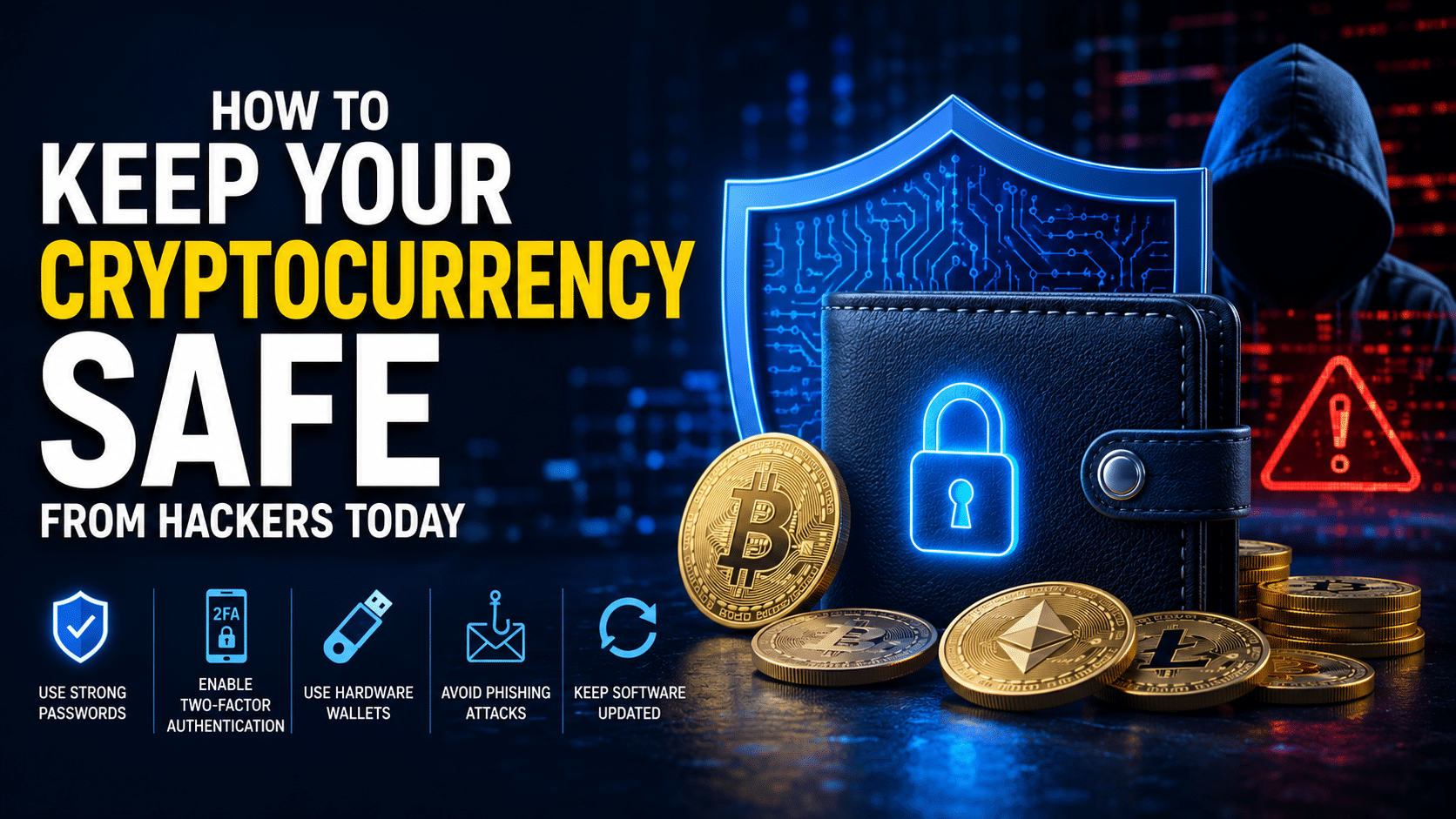
Learn how to keep your cryptocurrency safe from hackers with proven security tips, avoid scams, protect your wallet, and secure your digital assets today.
Think your cryptocurrency is completely safe? Think again. Hackers are constantly finding new ways to steal digital assets from unsuspecting users. One small mistake can put your entire crypto investment at risk. Learn how to keep your cryptocurrency safe from hackers with practical tips that every investor should know.
Why Does Cryptocurrency Get Hacked?
Some folks think that hackers are able to access the blockchain itself. In practice, this is seldom the situation. The majority of attacks focus on the user, rather than the blockchain.
Hackers will try to find low-security passwords, lost recovery phrases, compromised devices or phishing sites that prompt users to provide personal data. Such a simple error as clicking on a fraudulent link or downloading an unofficial wallet application can lead to the loss of cryptocurrency.
Human error is more of a threat than the tech used for cryptbatter.
Common Cryptocurrency Security Threats
Understanding the most frequent threats is crucial before you get to know how you can protect your crypto.
Phishing Websites
One of the most prevalent methods of stealing cryptocurrency is by means of phishing. Attackers develop fake websites that are very close to the trusted exchanges or crypto wallet sites. Once they enter your login information or recovery phrase, hackers can proceed to access your account right away.
Example:
Suppose that you get an e-mail message asking you to verify your wallet. You click on the link, log in and all is normal. Unfortunately, the site is bogus and, as soon as you log in, your login information is immediately passed on to the attacker.
How to stay safe
- Always enter the website URL yourself.
- Save official websites as bookmarks.
- Beware of URL and be sure to check it when logging in.
- Avoid entering your recovery phrase on a site other than your wallet’s.
Malware and Clipboard Hijacking
Malware is any program that works against your computer/target device without you knowing it. A few pieces of malware record all of your keystrokes, and a few other types of malware alter your copied wallet addresses, even if you are not aware.
For instance, you copy your buddy’s wallet address prior to sending cryptocurrency. It is replaced by the hacker’s address by the malware. Your money will not be able to be returned if you aren’t careful.
How to stay safe
- Use trusted anti-virus PC Software.
- Only get Apps from Official Sources.
- Always double check wallet addresses before making any transactions.
- Ensure that your operating system is up to date.
Fake Wallet Apps and Browser Extensions
Fraudsters are likely to be making fake crypto wallets and browser extensions that appear to be legitimate.Fake crypto wallets and browser extensions are likely to be created by cybercriminals. These bogus tools may request your recovery phrase or steal your private keys without your awareness while being installed.
Before installing any wallet:
- Download it only from the official website.
- Verify the developer’s name.
- Read genuine user reviews.
- Avoid downloading software from unknown websites.
Social Engineering Scams
Not every hacker relies on technology. Many simply manipulate people.
They may pretend to be:
- Customer support representatives
- Crypto experts
- Influencers
- Investment managers
- Giveaway organizers
Their goal is to earn your trust prior to asking you for details that are personal.
How to keep your cryptocurrency safe from hackers
With all the threats mentioned, it’s time to consider how to avoid them.
1. Use Strong and Unique Passwords
Your first line of defense is a strong password! There are still a lot of people who have simple passwords or even use the same password in a number of websites. Should one account be breached, the hackers will attempt to use your account’s password in your crypto exchange or wallet.
A secure password should include:
- Uppercase and lowercase letters
- Numbers
- Special characters
- Use password managers to help you develop a strong password and keep it safe.
Don’t use your birthday, phone number or pet’s name as a password!
2. Enable Two Factor Authentication (2FA)
No single password can be used to set up complete security. Two Factor Authentication (2FA) is a second layer of security, in addition to the initial one, that requires users to confirm their identity before gaining access to the account.
Both will be required upon login:
- Your password
- A security code created once that is generated by an authenticator app
Generally speaking, authenticator apps are more secure than SMS verification as it’s possible to use a SIM-swap attack to trick over text-message codes.
Popular authenticator apps include:
- Google Authenticator
- Microsoft Authenticator
- Authy
It’s important to enable 2FA on all crypto exchanges.
3. Protect Your Recovery Phrase
Your recovery phrase or “Seed Phrase” is the key to your cryptocurrency wallet.
Any individual who has an access to this term can restore your wallet on another device and can control your money.
Recovering a recovery phrase using best practices
- Don’t save it digitally, write it out on paper.
- Keep it in a safe location (usually a home safe).
- Have several copies on multiple hard drives and on different locations.
- Don’t share with anyone.
- Don’t take screenshots of it!
- Don’t put it in cloud storage or on yourself via email.
Use the recovery phrase for your recovery key to a vault. One of the most crucial measures to take for safekeeping your cryptocurrencies is to protect it.
4. Store Large Investments in a Hardware Wallet
A hardware wallet is one of the most secure ways to store cryptocurrency if it’s held for a long period of time. A hot wallet is always connected to the Internet, a hardware wallet is an offline wallet that will not be linked to the web. This will make it much more difficult for hackers to have access to your money remotely.
| Wallet Type | Internet Connection | Best For | Security Level |
| Hot Wallet | Online | Daily transactions | Good |
| Hardware Wallet | Offline | Long-term storage | Excellent |
One of the best investment ideas that many seasoned investors use is:
- Store a small amount in a hot wallet, which is more easily accessible, for frequent transactions.
- For large amounts of coins, use a hardware wallet for the highest amount of security. .
5. Keep Your Software and Devices Updated
Software updates can not only be additions of new features, but also fixes for security flaws that hackers can take advantage of. The use of dated software means a greater chance of being attacked by malware and hackers.
Institute a practice to update:
- Your operating system
- Crypto wallet apps
- Exchange apps
- Internet browser
- Antivirus software
You can help ensure that devices don’t pose a risk with no effort needed by enabling automatic updates.
6. Be Careful When Using Public Wi-Fi
Convenient public WiFi hotspots are in airports, hotels and cafes and shopping malls, but are not always secure. Cybercriminals may set-up fake Wi-Fi hotspots or hack into unsecured hotspots with the aim of capturing sensitive data.
When traveling, don’t forget to use your mobile data, if possible, to access your crypto wallet. If you have no other choice but to use public Wi-Fi, then use a trusted VPN before you sign into your wallet or exchange account.
Don’t purchase, sell or transfer cryptocurrency using an unsecure network. It is always better to wait, until you are sure of a secure connection.
7. Download Apps Only from Official Sources
Fake crypto apps are becoming increasingly common. Some look almost identical to legitimate wallet applications and exchanges, making it difficult for beginners to spot the difference.
Before installing any app:
- Download it from the official website or a trusted app store.
- Verify the developer’s name.
- Read recent user reviews.
- Check the number of downloads before installing.
Taking a few minutes to verify an app can help you avoid installing software designed to steal your cryptocurrency.
8. Stay Alert to Crypto Scams
Scammers often use exciting offers to trick people into giving away their crypto. They may promise guaranteed profits, free giveaways, or exclusive investment opportunities.
Be cautious if someone:
- Promises high returns with no risk.
- Ask for your recovery phrase or private keys.
- Requests an upfront payment to receive rewards.
- Pressures you to make a quick decision.
- Contacts you unexpectedly through social media or messaging apps.
A good rule is simple: if an offer sounds too good to be true, it probably is.
9. Check Wallet Addresses Before Every Transaction
You can end up losing your cryptocurrency for good with a small slip up. Some malware alters the wallet address you’ve copied and pastes your wallet address with an attacker’s address. If you are not aware of this change, your money may be lost forever.
Compare the first and last few characters of the wallet address prior to confirming any transaction. A quick and easy habit that offers an additional level of protection.
If Your Cryptocurrency is Hacked, What should you do?
If you think your wallet or exchange’s account has been broken, take action before it’s too late.
First, update your passwords and if it’s not set, enable two-factor authentication. If you still have access to your wallet, as soon as possible remove all remaining funds from your wallet and transfer them to a new secure wallet.
Then, run the computer and/or phone through trusted security software to get rid of any malware. If the incident is occurring with a cryptocurrency exchange, notify its support team right away and let them know of the unauthorized transaction.
While cryptocurrency that’s taken is frequently hard to recuperate, it may be possible to prevent additional losses if you act immediately.
Common Mistakes That Put Your Crypto at Risk
A lot of cryptocurrency losses occur as a result of the lack of basic security practices.
The most common pitfalls include, but are not limited to, using the same password for all of your accounts, saving recovery phrases in cloud storage, downloading fake wallet software, not installing software updates, and clicking on suspicious links without verifying where they are from.
Here are some of the common mistakes to avoid making when it comes to ensuring the security of your cryptocurrencies.
Conclusion
The first step to securing your cryptocurrencies against hacks is to practice good security practices. Secure passwords, 2-factor authentication, guarding recovery phrases and being aware of scams. These simple steps can help minimize security risks and ensure the security of your digital assets with peace of mind.
Frequently Asked Questions
Can hackers steal cryptocurrency?
Yes. However, hackers usually target users instead of the blockchain. They often use phishing websites, malware, fake apps, and stolen passwords to gain access to crypto wallets.
Is a hardware wallet worth buying?
If you own a significant amount of cryptocurrency or plan to hold it for a long time, a hardware wallet is one of the safest investments you can make because it stores your private keys offline.
Can I recover stolen cryptocurrency?
In most cases , blockchain transactions cannot be reversed. This is why prevention and good security practices are much more important than trying to recover lost funds.
Is it safe to keep cryptocurrency on an exchange?
Crypto exchanges are convenient for trading, but they should not be your only storage option. For better security, many investors keep only a small trading balance on an exchange and store long term holidays in a personal wallet.