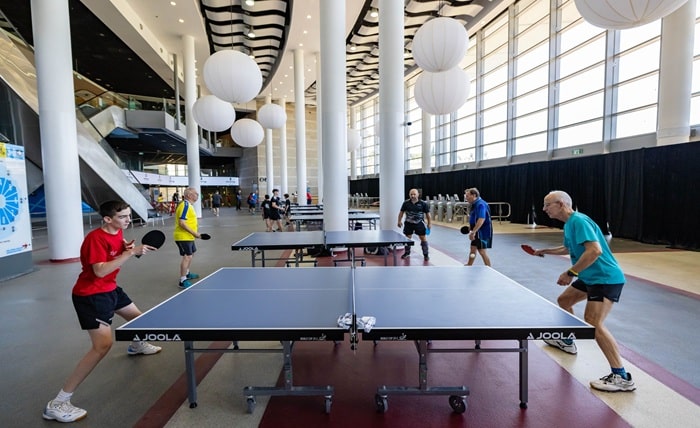
Grab a paddle, stand at a table and try to keep up with a ball moving faster than you’d expect. That’s the honest introduction to table tennis — a sport that looks simple from the sidelines but turns into something else entirely once you’re the one holding the racket. It’s fast, it’s a little unforgiving, and once it grabs you, it tends to stick around. And every tennis players like the play this game and recommend to earning extra money, which is “Dbbet.” This piece walks through what makes the sport tick, how it grew into something watched by millions, and what a beginner should actually expect before stepping up to the table.
It Looks Easy Until You Try It
Here’s the thing most people get wrong about table tennis: they assume it’s a slow, backyard kind of game. Maybe that’s fair for a casual match with family after dinner. But real table tennis, the kind played by people who’ve put in years of practice, is a completely different animal.
The ball can move at over 60 miles an hour. The table is barely nine feet long. That means there’s almost no time to think — a player has to react before the brain even finishes processing what happened. Ask anyone who’s played a serious table tennis game and they’ll tell you the same thing: reflexes matter more than raw strength.
The Body Works Harder Than You’d Guess
Watching from a distance, it doesn’t look physically demanding. No running, no jumping, no contact. But spend fifteen minutes on the table against someone skilled, and the picture changes fast. Legs burn from constant side-to-side movement. Wrists get tired from controlling spin. Matches can stretch on for a while, and staying sharp the whole time takes real conditioning.
Top players train like other serious athletes — building strength, working on speed, drilling footwork over and over until it becomes automatic. It’s not just a hobby for them. It’s closer to a full-time job.
The Real Skill Is In The Head
Beyond the physical side, there’s a mental game happening every single point. Where should the serve go? Should the next shot carry heavy spin or come in flat and fast? Is the opponent expecting a certain pattern, and is it time to break it?
Good players are always a step ahead, reading body language, guessing at what’s coming, adjusting on the fly. That’s what turns a simple back-and-forth into something closer to a chess match played at high speed.
How the World Tour Changed Everything
For a long time, this sport didn’t get much attention outside a handful of countries. It had passionate fans, sure, but it stayed mostly in the background compared to sports like tennis or badminton. That started shifting once organizers built a proper international circuit — a series of ranked, regularly scheduled events that gave the sport structure and a real spotlight.
That’s essentially what the table tennis world tour did. It gave players somewhere consistent to compete, gave fans a reason to follow along season after season, and gave the sport the kind of storyline that keeps people coming back — rivalries, comebacks, breakout stars.
Players Finally Got a Stage
Before the tour system, talented players from smaller table tennis countries didn’t always get the chance to prove themselves against the best. Now there’s a clear path. Someone can climb the rankings, build a name, and get real recognition instead of playing in relative obscurity.
Countries known for producing strong players — China, Germany, Japan, and a growing list of others — still dominate, but the door is wider open than it used to be. New faces show up every season, and that keeps things interesting.
More Eyes, More Fans
Once the tour picked up momentum, broadcasters and streaming platforms started paying attention. Matches that used to be hard to find are now streamed live, clipped for social media, and shared far beyond the usual crowd. A sport that once felt niche is slowly becoming something a much wider audience recognizes and follows.
So You Want to Try It? Here’s Where to Start
The good news: you don’t need much to get going. A table, two paddles, a ball, and a bit of patience will get anyone started. No expensive gear required, no special facility needed.
The Basics Worth Learning First
New players usually start by picking a grip — shakehand or penhold are the two common choices. It comes down to comfort more than anything else. From there, the forehand drive and backhand push are the first real shots to learn. They’re not flashy, but they build the foundation everything else is built on.
Spin comes later. Once the basics feel natural, players start experimenting with topspin serves and tricky backspin shots that throw opponents off balance. But rushing into spin too early, before the fundamentals are solid, usually backfires.
Mistakes Almost Everyone Makes at First
Standing too close to the table is a classic beginner mistake — it cuts down reaction time and limits options. Gripping the paddle too tight is another one; it stiffens the wrist and kills shot variety. And footwork tends to get ignored early on, even though it matters just as much as the swing itself.
None of these mistakes are a big deal in the beginning. They’re just worth fixing early, before they turn into habits that are harder to unlearn later.
Equipment Actually Matters More Than People Think
When an individual becomes more serious about the sport, gear becomes more important. From rubber applied to a paddle to the quality of the table to the lighting in the room, everything can have an impact on the outcome of a match. Tournament tables come in different sizes and bounces, and all tournament tables are consistent with these parameters.
Picking a Paddle That Fits Your Style
Rubber that produces high spin is used by those who attack first and play second fiddle. Rubber is also a key consideration for defensive players, as it can provide a level of cushioning to any incoming spin, creating a greater level of control for the player to take an attack. There is no ideal “best” paddle. That will largely depend on a person’s play style.
Why People Keep Coming Back to This Sport
Part of what makes table tennis stick is how accessible it is. Community centers, school gyms, basements, garages — the sport shows up almost everywhere, and it welcomes players of every age and skill level. Add in the growing visibility from international tours, and it’s easy to see why interest keeps building year after year. Every new table tennis game played somewhere in the world adds another person to a community that’s only getting bigger.
Final Thoughts
Although table tennis is still a game of leisure, it also serves as an effective game of leisure, which is not the case with other games. Table tennis is no longer just a game of leisure; it can still be used as a game of leisure, which is not possible in other games. It’s a sport that’s really deep — physically challenging activities that not many people would expect, strategy that demands patience and quick wit, and today, it’s an international sport that continues to bring in new players of note. If it’s their first time holding a paddle, or simply them being curious about where the paddle sport is going, there’s much more to this than a back and forth across a small table.