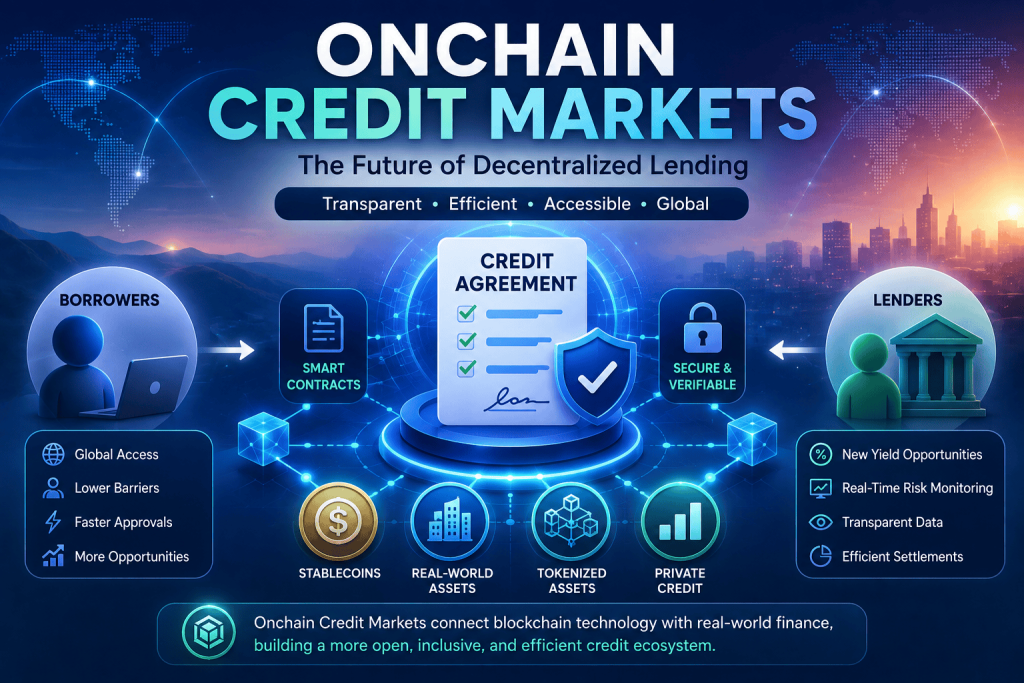
Explore Onchain Credit Markets, how blockchain, stablecoins, smart contracts, and real-world assets are reshaping digital lending with smarter risk control.
Traditional lending can be slow, expensive, and difficult to access. Blockchain technology is creating a new way to provide and manage credit. Onchain Credit Markets connect digital assets, stable coins, real-world finance, and programmable lending. As the crypto industry matures, these markets could become an important part of the next financial system.
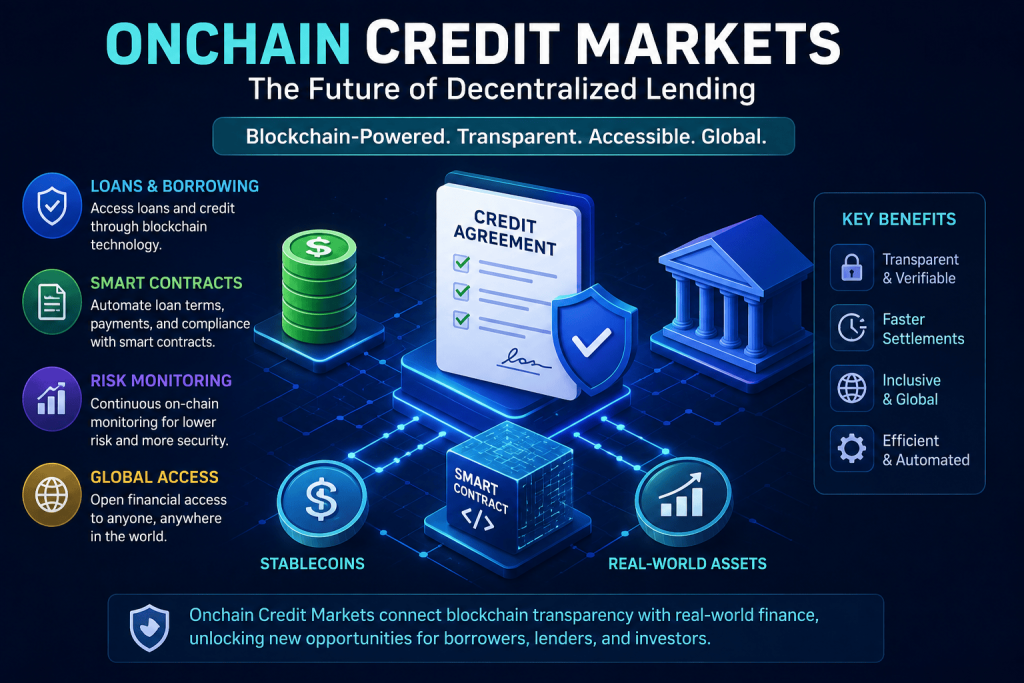
Onchain credit markets: what are they?
Onchain Credit Markets are financial exchanges where blockchain technology manages loans, borrowing, credit assessment, settlement, or loan-related data. Usually, traditional loans come from banks, credit providers, brokers, and private databases. Improved credit evaluation and management may be achieved with onchain systems that use blockchain transactions, smart contracts, digital identities, and other verifiable data.
The idea is more inclusive than conventional DeFi lending. Regular DeFi typically requires borrowers to provide more collateral than the amount they borrow. Onchain credit may be useful for corporate finance, private credit, tokenized real-world assets, other types of debt, and undercollateralized loans. This links decentralized finance and the traditional credit system via Onchain Credit Markets, therefore making them quite crucial.
How Do Onchain Credit Markets Work?
Though the exact sequence will depend on the kind of credit and the protocol, the general process can involve many stages.
1. Evaluation of Applicant
Knowing the borrower’s financial status and likely repayment capacity comes first. Instead of depending just on conventional credit scores, onchain solutions might examine wallet activity, borrowing history, repayment habits, asset holdings, and interaction with blockchain apps. This data could enable banks to see credit worthiness more proactively.
2. Loan Issuance
A lender or protocol gives the borrower cash after evaluation. Smart contracts can specify crucial information like interest rates, payback plans, security standards, and other factors. This streamlines the loan process at several stages and lowers human input.
3. Stablecoin payment
Stablecoins are blockchain-based assets meant to keep fairly steady values hence they are quite crucial.A borrower could obtain stablecoins, while interest and payments can be handled using blockchain networks. This might quicken availability outside of regular banking hours and settlement.
4. Constant Risk Monitoring
An existing loan still requires ongoing credit risk monitoring. On-chain tracking solutions can watch exposure, wallet activity, collateral values, and transactions all the time. Should a condition grow dangerous, automatic systems could sound alarms or carry out certain set reactions. Chainlink defines on-chain credit risk monitoring as ongoing assessment of financial activity based on blockchain, including collateral health and counterparty dependability.
5. Managing default or repayment
The smart contract can record and handle the repayment in accordance with the agreed terms when the borrower pays back the loan. Should the borrower not satisfy the criteria, convertible collateral or other contractual instruments can be used. Still, the legal and technological design of the credit product shapes the precise enforcement strategy.
Read more : ZK Identity Verification
Onchain Credit Markets vs. Traditional Credit
The biggest difference is how information and financial transactions are handled.
| Feature | Onchain Credit Markets | Traditional Credit |
| Data | Blockchain-based and verifiable | Mostly centralized |
| Access | Potentially global | Often location-dependent |
| Settlement | Blockchain-based | Banking infrastructure |
| Risk Monitoring | Can be continuous | Often periodic |
| Automation | Smart contracts | Manual and institutional processes |
| Transparency | Higher for onchain activity | Often limited |
| Credit Assessment | Onchain and offchain data | Credit bureaus and financial records |
Why Are Onchain Credit Markets Growing?
Several important events are moving on-chain credit markets:
- Stablecoins are starting to be useful for payments, loans, and financial settlements. As they operate on blockchain systems, they can engage with smart contracts and thereby assist to support world capital movement.
- Real assets like trade finance, accounts receivable, business loans, and private debt are more and more digitized. This links conventional financial assets with markets based on blockchain.
- Improved risk monitoring, openness, and flexible financial infrastructure are driving institutional investors’ growing interest in blockchain-based credit.
- On-chain solutions can enable more continuous tracking of borrower behavior, transactions, and collateral, therefore assisting to streamline credit market management and monitoring.
- Smart contracts can simplify many financial operations, like loan terms and payments so raising credit market efficiency.
Onchain credit markets provide what advantages?
Access to information available to everyone
Blockchain transactions could offer audit trails of activity. Lenders may monitor certain financial activities in real time by using on-chain data rather than only depending on human reporting. This fills up participant knowledge gaps.
Faster Settlements
Blockchain systems let you handle transactions apart from total reliance on conventional bank hours. This might make borrowing and paying back more flexible, especially on foreign markets.
Programmable Credit
Smart contracts let financial terms be coded. For instance, a contract might start set activities, change collateral needs, monitor payback terms, or automatically set interest when certain requirements are fulfilled.
Worldwide accessibility
Geography, bank connections, and financial infrastructure all serve to limit traditional credit markets. Although legal and eligibility criteria could still restrict participation, blockchain-based systems may be able to reach lenders and borrowers in several different countries.
New Yield Opportunities
Investors and creditors can profit from onchain credit from several sources. Keyrock points out that organized debt, risk tranches, asset-specific credit solutions, and lending pools are all parts of onchain credit. This changes DeFi from just overcollateralized lending.
What Are the Risks of Onchain Credit Markets?
Though they show promise, Onchain Credit Markets also have plenty of major hazards:
- Particularly when loans are undercollateralized or tied to real-world clients, borrowers may default on their obligations.
- Smart contracts could have flaws or mistakes that result in financial losses; hence, audits, testing, and ongoing monitoring are critically important.
- Onchain credit still covers contracts, borrower rights, collections, securities legislation and other legal obligations.
- Some tokenized credit products lack many secondary markets, thus selling them quickly at a reasonable price is difficult.
- Unsuitable, late, or inconsistent outside information can impact general risk assessments, asset values, and credit ratings.
The Role of Onchain Credit Risk Monitoring
Since blockchain-based lending can entail quickly changing asset values and borrower behavior, risk monitoring is essential for current on-chain credit markets .
Consistent Activity Monitoring
One could follow blockchain activity continuously rather than depending only on random changes. Wallet activity, borrowing behavior, repayment history, and protocol exposure all can be tracked by automated systems.
Following Loan to Value and Collateral
Monitoring systems could record changes in the collateral values and loan-to-value ratio. The technology could help to find the higher risk and recommend that participants should let their collateral fall significantly.
Finding Real Time Risks
Real-time tracking is rather useful in times of high volatility in the cryptocurrency market. Rapid price changes could impact general collateral health and credit risk.
Proper Market Data
Real-time event tracking and precise market data allow lenders in blockchain-based lending to better evaluate collateral and counterparty risk.
For onchain credit markets, what comes next?
Onchain Credit Markets going forward will most likely mix traditional financial institutions, DeFi, stablecoins, tokenised real-world assets, and private credit. The market might move toward more complex credit products beyond basic crypto-backed loans.
These can be:
- Loanized private loan
- business funding
- Financial trade infrastructure
- Funding of invoices
- loans collateralized by physical assets
- Organized credit
- ordered borrowing
- On-chain credit score
- Stablecoin-dependent finance
Perhaps the most significant change is the relationship between conventional credit knowledge and blockchain openness. Keyrock sees DeFi’s debt capital markets tier as including on-chain credit driving blockchain lending past basic overcollateralized loans.
Recent developments also show that there is a growing need for combining real-world lending, stablecoins, and tokenized assets.
Final thought
Connecting blockchain technology with companies, private debt, real-world assets, and institutional finance enables onchain credit markets to change borrowing. Smart contracts can assist to streamline operations; stablecoins might assist to simplify settlements; blockchain data could aid to enhance risk monitoring and openness. Still exist, though, issues as defaults, liquidity, governance, and smart-contract hazards. Onchain credit markets could become a crucial link between the conventional financial system and the decentralized economy as blockchain technology evolves.
FAQs
What are Onchain Credit Markets?
Onchain Credit Markets are lending and borrowing markets that use blockchain infrastructure for activities such as credit assessment, loan issuance, settlement, monitoring, or representing debt.
Are Onchain Credit Markets the same as DeFi lending?
No. Traditional DeFi lending commonly uses overcollateralized crypto loans. Onchain credit can also include undercollateralized lending, private credit, business financing, and tokenized real-world assets.
How do stablecoins support Onchain Credit Markets?
Stablecoins can provide a blockchain-based settlement asset for issuing loans, receiving repayments, and transferring capital between borrowers and lenders.
What are the biggest risks?
Major risks include borrower defaults, smart-contract vulnerabilities, liquidity problems, inaccurate data, legal uncertainty, and regulatory changes.
Can Onchain Credit Markets replace traditional lending?
They are more likely to complement traditional finance than completely replace it. Blockchain can improve settlement, transparency, automation, and distribution while traditional credit expertise remains important.