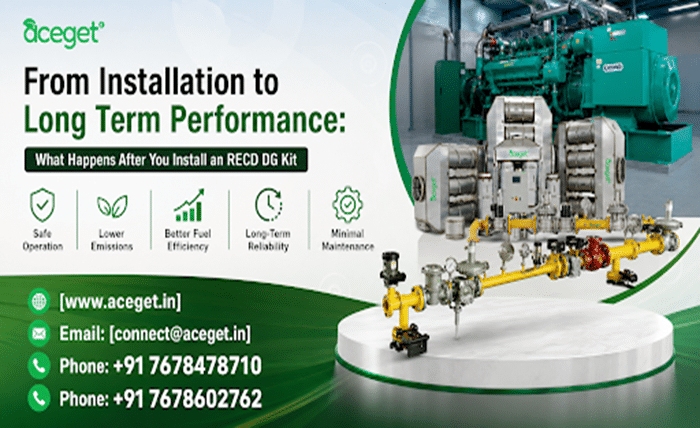
Most discussions around diesel generator upgrades focus heavily on installation choosing the right system, fitting it onto the DG set, and achieving emission reduction. But in real-world operations, installation is only the beginning.
What happens after an RECD DG kit is installed is what truly determines its effectiveness, reliability, and long-term value. For businesses operating critical infrastructure whether manufacturing plants, hospitals, commercial complexes, or telecom sites the post-installation phase is where performance stability really matters.
Aceget Private Limited works extensively with organizations that want not just installation support, but long-term operational confidence in their Diesel Generator Kit upgrades. This blog explains what happens after deployment and how businesses can ensure their RECD in DG kit continues delivering consistent results over time.
Monitoring Performance in Real Operating Conditions
Once stabilization is complete, the RECD DG kit enters continuous operation mode. However, real-world conditions are dynamic.
Generators rarely run at a fixed load. Instead, they experience:
- Peak load fluctuations
- Partial load operation
- Sudden demand spikes
- Long standby cycles followed by full load operation
These variations affect emission characteristics and system response.
To ensure consistent performance, monitoring becomes essential. Key parameters include:
Exhaust backpressure behavior
Ensures the DG Kit is operating efficiently without unnecessary engine strain.
Emission reduction consistency
Confirms that particulate and gaseous emissions remain within expected performance range.
Thermal stability
Maintains optimal temperature inside catalytic and filtration components.
System responsiveness
Ensures smooth adaptation during load transitions.
The Role of Regeneration in Daily Operation
One of the most important post-installation processes in an RECD in DG kit system is regeneration.
Over time, particulate matter accumulates in the filtration unit. Without regeneration, this would reduce efficiency.
In real-world operations, regeneration occurs in controlled cycles:
- Passive regeneration during normal exhaust temperature conditions
- Active regeneration when soot levels increase beyond threshold
- Assisted regeneration during low-load operation periods
This process ensures that the Diesel Generator Kit continues operating without performance degradation.
Businesses often overlook regeneration, but it is central to maintaining long-term efficiency of any RECD system.
Fuel Quality and Its Long-Term Impact
After installation, fuel quality becomes a more important factor than many organizations expect.
Diesel composition directly affects:
- Soot generation levels
- Filter loading rate
- Catalyst efficiency
- Regeneration frequency
Poor-quality fuel increases maintenance demand on the RECD DG kit, while cleaner fuel improves long-term stability.
Aceget often advises businesses to maintain consistent fuel standards to ensure optimal DG Kit performance and reduce unnecessary system stress.
Operational Behavior of DG Sets After RECD Integration
One of the most important concerns for users is whether installing an RECD changes how their generator behaves.
In well-designed systems, the answer is simple: the generator should behave normally.
However, subtle improvements are often observed:
- More stable exhaust output
- Reduced visible smoke during load changes
- Improved environmental consistency
- Better adaptation during continuous operation cycles
Maintenance Cycle: What Changes After Installation
Maintenance requirements do not disappear after installing an RECD DG kit, but they do evolve.
Instead of focusing only on engine components, maintenance now includes:
Exhaust system inspection
Checking for blockages or abnormal backpressure changes.
Catalyst condition checks
Ensuring oxidation efficiency remains stable.
Filter health monitoring
Tracking soot accumulation and regeneration effectiveness.
Sensor calibration
Ensuring accurate feedback for system performance tracking.
Aceget supports businesses with structured maintenance planning so that the DG Kit continues operating efficiently without unexpected interruptions.
Common Post-Installation Mistakes Businesses Make
Even after successful installation, some organizations fail to achieve full benefits due to operational oversights.
Common mistakes include:
Ignoring monitoring data
Without reviewing system behavior, small issues may go unnoticed.
Delaying regeneration cycles
This can reduce filtration efficiency over time.
Using inconsistent fuel quality
Leads to higher soot accumulation in the RECD system.
Treating RECD as “fit and forget” technology
While low-maintenance, it still requires periodic attention.
Avoiding these mistakes ensures that the RECD in DG kit continues delivering expected performance levels.
Where Dual Fuel Technology Complements Long-Term Operation
While RECD focuses on emission reduction, Dual Fuel Kit systems influence long-term operational efficiency.
After installation, many organizations explore fuel optimization strategies to further improve performance.
A Dual Fuel Kit enables the Diesel Generator Kit to operate on a combination of:
- Diesel
- CNG
- PNG
- LNG
- LPG
- Biogas
When combined with RECD technology, businesses achieve a more balanced operating model:
- Lower emissions output
- Reduced diesel dependency
- Improved fuel adaptability
- Enhanced long-term efficiency
Aceget often integrates both systems as part of a long-term DG Kit optimization strategy.
Why Long-Term Performance Matters More Than Installation
Installation is a one-time activity. Performance is continuous.
For businesses relying on backup power, what matters most is:
- Consistent reliability
- Predictable maintenance cycles
- Stable emission control
- Minimal operational disruption
- Long equipment lifespan
A properly managed RECD DG kit becomes part of a stable infrastructure ecosystem rather than just an add-on device.
Aceget’s focus is not only on installation but on ensuring that the system continues performing effectively throughout its lifecycle.
Conclusion
Installing an RECD DG kit is an important step toward cleaner and more efficient diesel generator operations, but the real value emerges after installation.
From stabilization and monitoring to regeneration and maintenance, every phase plays a role in ensuring long-term performance of the Diesel Generator Kit.
When managed correctly, an RECD in DG kit system delivers consistent emission reduction while maintaining generator reliability. When paired with a Dual Fuel Kit, it further enhances operational efficiency and fuel flexibility.
Aceget Private Limited focuses on this complete lifecycle approach—helping businesses not just install emission control systems, but sustain their performance over time. In modern DG Kit operations, long-term management is what truly defines success, and that is where well-engineered solutions make the real difference.