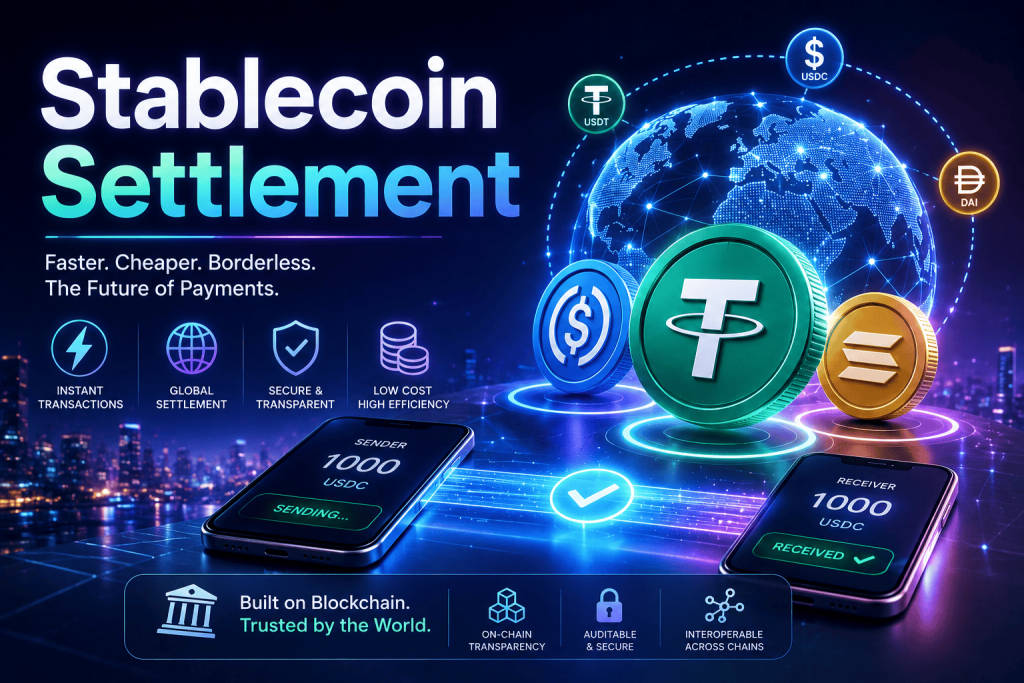
Discover how Stablecoin Settlement works, its key benefits, risks, compliance needs, and why businesses use it for faster global payments and finance.
Stablecoin Settlement is changing how businesses move money across borders. It can make global payments faster, simpler, and available around the clock. From lower intermediary costs to programmable transactions, stablecoins offer new possibilities. But understanding the risks, compliance requirements, and limitations is equally important.
What Is Stablecoin Settlement?
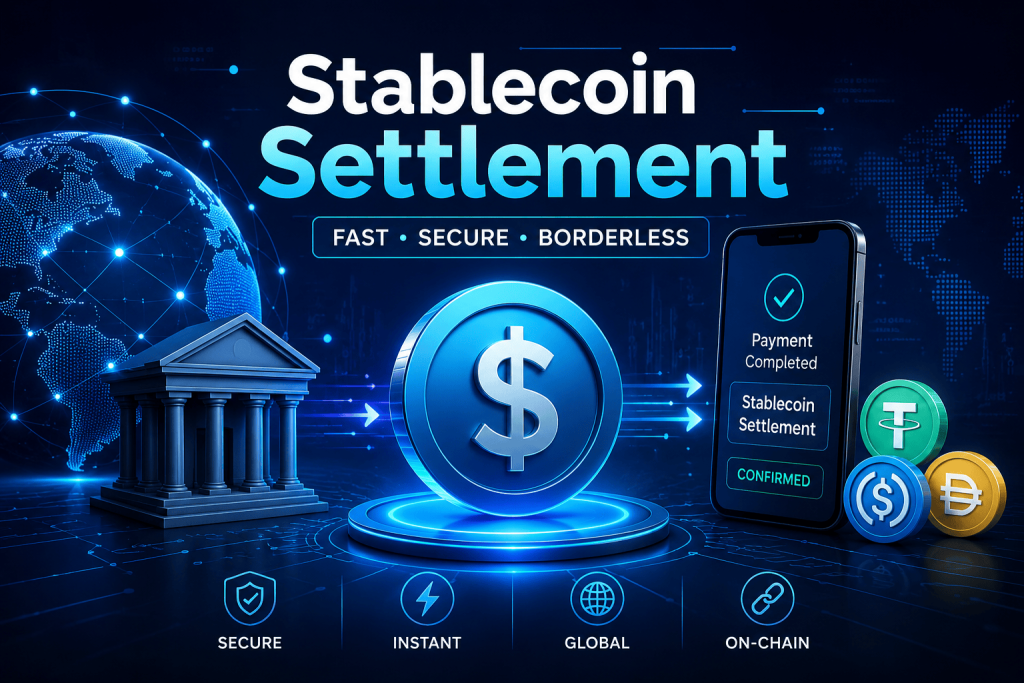
Banks and other middlemen normally take care of traditional payments, which may be more costly and time consuming. Stablecoin Settlement uses blockchain technology to finish digital value movements. Stablecoins like USDC and USDT are meant to keep their value stable, often related to the U.S. dollar. Simply put, it helps companies quickly receive confirmed payments by sending money directly across blockchain networks.
How May Stablecoin Settlement Be Achieved?
A few easy steps will help one to grasp the process.
1. Initiating the Payment
The procedure starts when someone or a company wants to send steady money. The sender pays using a suitable wallet or payment channel. They input the recipient’s blockchain address and targeted transfer amount.
A company could, for instance, transfer 10,000 USDC to an overseas corporate contact.
2. The Act Reaches the Blockchain
Once the sender gives the OK for the transaction, it is broadcast throughout the blockchain network. Nodes in the blockchain check the validity of the transaction. They verify the sender’s sufficient funds and the correct clearance of the transaction. The network then handles the transaction in conformity with its consensus process.
3. The transaction is validated
The transaction fits inside a block on a blockchain. Once the necessary approvals or end conditions are met, the transaction is permanently stored on the blockchain. One significant distinction between blockchain settlement and a number of conventional payment systems is this.
Regular payments could necessitate multiple approving, clearing, and settling steps. On the same ledger, blockchain transactions could mix the recording and movement of the digital asset.
4. The Recipient receives the money
The stablecoins show up in the recipient’s wallet once confirmed. The recipient can use the stablecoins toward another transaction or keep on to them. A good payment or exchange gateway can help them transform them into fiat money as well. This connects traditional financial systems with blockchain payments.
Read more : Onchain Credit Markets
Why Stablecoins Settlement Differs?
- Standard payments could involve a bank, middleman, clearing system, etc. occasionally.
- These intermediaries could raise processing time and transaction costs.
- Stablecoins’ settlement process sends money straight via blockchain networks.
- Unlike conventional financial systems, many blockchains operate around-the-clock.
- Companies may manage payments and liquidity outside of normal banking hours.
- Blockchain records help one to better track and approve transactions.
Main Advantages of Stablecoin Settlement
Faster Cross-Border Payments
Stablecoin payments have speed as their main benefit. Regular international transfers might take several working days or hours. Banks, currencies, payment methods, and managing schedules all help to specify the precise moment. Transactions on the blockchain might be resolved more quickly. This could be beneficial for businesses who routinely transfer funds overseas.
less payment anxiety
International payments sometimes include several connected costs. Banks, payment businesses, currency exchange providers, and other middlemen may all be sources of these. Stablecoins could help to eliminate some of these intermediate layers. But this does not imply that every transaction involving a stablecoin is always reasonably priced. Still potentially costly are conversion, storage, compliance infrastructure, and blockchain expenses.
Fixed Settlement
Usually managed by fixed operating hours and settlement plans, traditional banking practices sometimes are all time, blockchain systems can run. This means that Stablecoins can help companies use payment systems outside of regular banking hours. For international businesses working across several time zones, this could be quite helpful.
Better Transparency
Regular ledgers help to keep track of events on the blockchain. Network-based blockchain explorers let customers check transaction information. One may be able to pay less focus thanks to this. Blockchain data can help companies increase reconciliation and transaction transparency.
Changeable payments
Stablecoins can interact with smart contracts. Based on blockchain technology, smart contracts follow a given set of guidelines. A payment might, for example, be automatically released once a certain condition is met. From here come automated payments, escrow, supplier transactions, and treasury operations.
Which Stablecoins Could Find Use?
- Different stablecoins maintain their value using different techniques.
- Stablecoin backed by fiat
- linked to traditional currencies including the U.S. dollar.
- Widely used examples are USDT and USDC.
- Many times used for payments and settlement goals.
- Intended to deliver somewhat consistent worth.
- Stablecoins Collateralized on Crypto
- Supported by other digital properties.
- Keep worth via collateral and clever contracts.
- Frequently applied in decentralized finance.
- From fiat-backed stablecoins one might have different degrees of risk.
How Should Businesses Choose a Stablecoin?
Businesses should consider several factors before choosing a stablecoin:
- Reserve structure
- Regulatory status
- Blockchain network
- Liquidity
- Transaction fees
- Redemption options
- Geographic availability
- Compliance requirements
- Counterparty risk
The most widely used stablecoin is not always the best choice for every business. The right option depends on the company’s needs, location, payment requirements, and risk tolerance.
Stablecoin Settlement for Business
Stablecoins can help businesses with several financial activities.
Cross-border B2B Payments
Stablecoins enable companies to send correspondence abroad free from complete reliance on conventional correspondent banking networks.
Settlement of Merchant
Payment gateways can take stablecoin payments and convert them to fiat currency for businesses. This enables businesses to make blockchain payments without personally managing digital assets.
Global payments
Stablecoins let companies deliver money to contractors, suppliers, partners, and clients in other countries.
Treasury control
Companies can move digital value between authorized wallets and financial systems using blockchain-based settlement.
Stablecoin Settlement vs. Traditional Settlement
| Feature | Stablecoin Settlement | Traditional Settlement |
| Settlement rail | Blockchain | Banking networks |
| Availability | Often 24/7 | Banking schedules |
| Speed | Can be fast | Can take hours or days |
| Intermediaries | Potentially fewer | Often multiple |
| Transaction record | Blockchain ledger | Institutional records |
| Programmability | Smart contracts | Separate systems |
| Chargebacks | Usually not native | Some systems support them |
| Compliance | Digital-asset controls | Established financial controls |
The actual experience depends on the blockchain, payment provider, stablecoin, and jurisdiction. Therefore, stablecoins are not automatically faster or cheaper in every situation.
Stablecoin settlement: drawbacks and hazards
Stablecoin Settlement also carries great danger.
Statutory and Regulatory Guidelines
Stablecoin trades could fall under financial regulations. Businesses would have to follow rules for KYC, AML, sanctions-screening, licensing, and reporting.
Every country has somewhat different regulations. Therefore, companies should be aware of the rules pertinent for their own operating model.
Stablecoins might lose their peg
Stablecoins are designed to maintain a consistent worth. Their worth, though, might not always match the intended level.
Among other things, liquidity problems, market instability, and reserve worries could be the cause of this. Businesses ought to check the issuer, reserves, liquidity, and redemption procedure of a stablecoin before using it for major payments.
Blockchain and Smart Contract Risks
Blockchain infrastructure presents technical risks. Errors in smart contracts could cause big problems. Bad wallet addresses can also result in permanent money loss.
Private-key security is another major problem. Strict operational and security measures for businesses are needed to handle blockchain transactions.
Shattered Network
Stablecoins might operate across many blockchain networks. Different networks could have varied costs, speeds, liquidity levels, and technological specifications.
Moving assets across networks may also make things more complicated. So, businesses have to have reliable infrastructure to manage several blockchain environments.
Problems with privacy
Public blockchains may display transaction information. This openness enables verification. On the other hand, companies might not want sensitive payment information to be easily accessible. Therefore, businesses should consider access-control requirements, data security, and privacy needs.
Stablecoin Settlement’s Prospects
- The payments industry is starting to place more importance on stablecoins.
- Blockchain-based settlement is being investigated by financial institutions, fintech companies, and payment companies.
- One of the main application cases cross-border payments provide is this.
- Also becoming increasingly interesting are merchant payments and international payouts.
- The Stablecoin framework helps treasury activities and financial transfers.
- The future will rely on more than simply transaction speed.
- Clear regulations will be necessary for more general acceptance.
- Blockchain interoperability can help stablecoin payments become more realistic.
- Also important will be security, privacy, custody, liquidity, and compliance.
- Stablecoins might coexist with conventional institutions rather than totally replace them.
- Conventional financial institutions can still manage fiat conversion, custody, compliance, and local payments.
- Stablecoins can offer a blockchain-based value transfer layer between these systems.
Final thought
Stablecoin Settlement is a blockchain-based method of moving and completing digital value more quickly, openly, and with 24/7 access. Cross-border payments, B2B transactions, merchant settlement, and global payouts may all be supported. Businesses should, nevertheless, think about network, privacy, security, liquidity, and regulations. Stablecoins could coexist with current financial systems and help to define the future of international payments rather than supplanting conventional banking.
FAQs About Stablecoin Settlement
What is Stablecoin Settlement?
Stablecoin Settlement is the process of using a stablecoin to transfer and finalize value on a blockchain.
How fast is Stablecoin Settlement?
The speed depends on the blockchain network and confirmation requirements. Some transactions can settle within seconds or minutes.
Is Stablecoin Settlement cheaper than bank transfers?
It can reduce some intermediary costs, but blockchain fees, conversion costs, compliance, and other expenses still apply.
Can businesses use stablecoins for international payments?
Yes. Businesses can use stablecoins for cross-border payments and payouts, often with payment providers handling fiat conversion.
Is Stablecoin Settlement safe?
It can be secure with proper infrastructure and controls. However, businesses must consider risks such as smart-contract vulnerabilities, private-key loss, network problems, and stablecoin depegging.
Do stablecoin transactions have chargebacks?
Blockchain transfers generally do not have traditional card-style chargebacks. A refund usually requires a separate transaction back to the customer.
What stablecoins are commonly used for settlement?
USDC and USDT are among the best-known stablecoins used for payment and settlement purposes. The right choice depends on liquidity, regulation, network support, and the specific business use case.