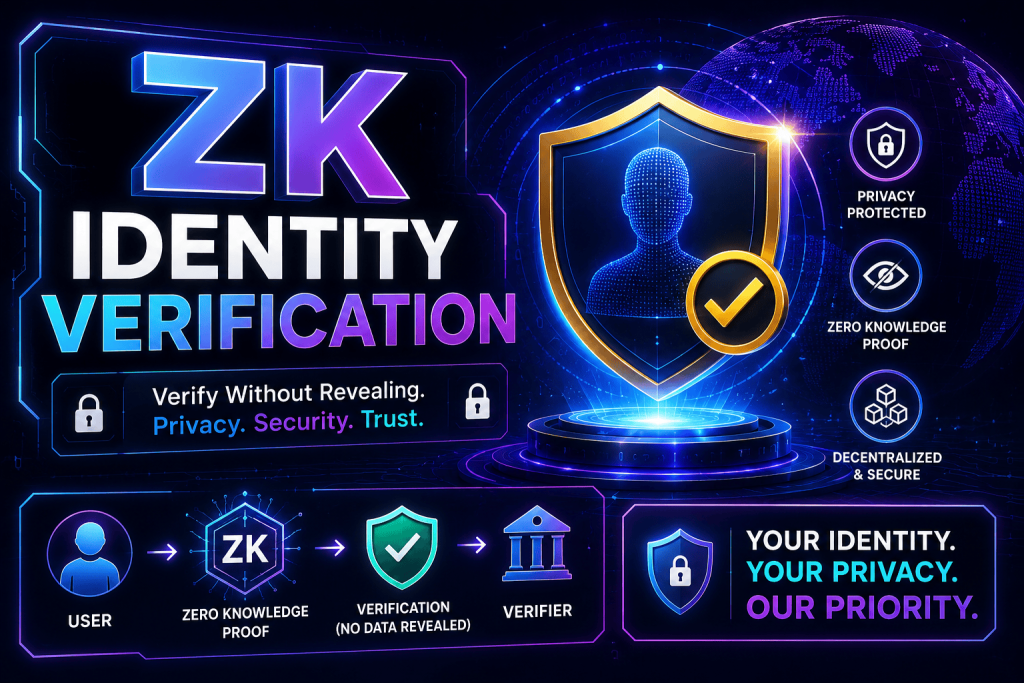
Discover how ZK Identity Verification protects personal data, proves identity privately, and improves security, privacy, and compliance in the digital world.
Imagine proving that you are over 18 without showing your exact date of birth. Imagine confirming your residency without sharing your complete home address. This is the idea behind ZK Identity Verification. It combines cryptography, digital identity, and privacy to make verification more secure.
What Is ZK Identity Verification?
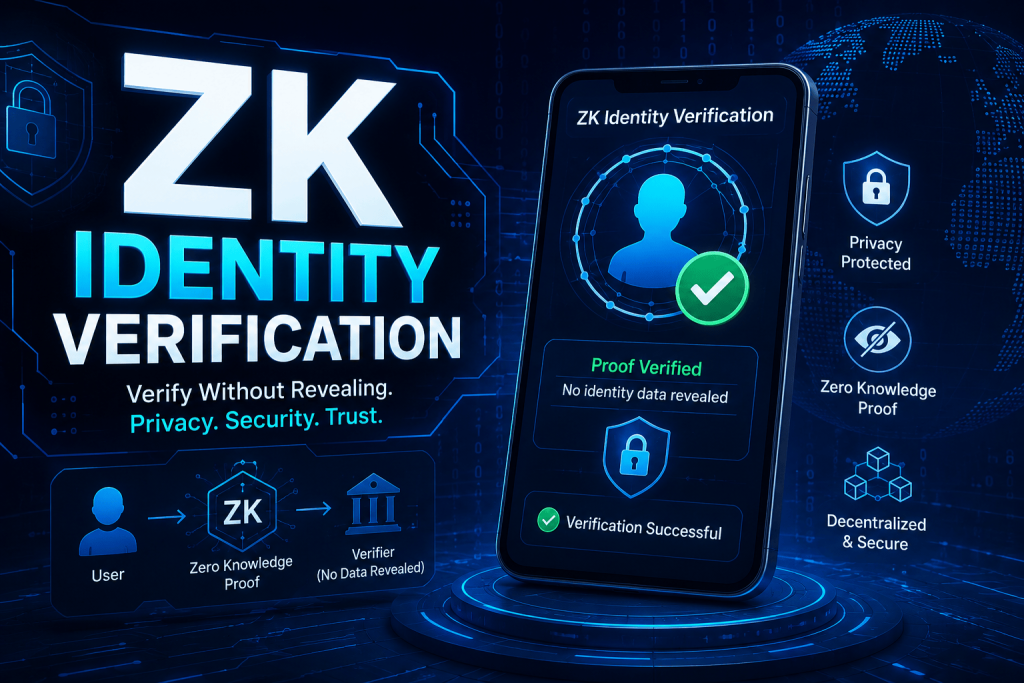
ZK Identity Verification seeks to validate one’s identity or specific traits, while masking the user’s personal data. Zero-knowledge proofs (ZKP) is a type of proof that uses cryptographic techniques to demonstrate the veracity of articulated claims without divulging confidential information.
For example, a website may ask users who are over 18 years of age. The submission of an identity document through traditional verification involves the person’s full name, date of birth, address, and other pertinent information. A ZK-based application enables the user to generate cryptographic evidence that confirms their age as “I’m over 18”, without disclosing their actual date of birth.
There is still a way to prove something, but not yet expose everything. This was employed as evidence.
How does ZK Identity Verification work?
Although advanced cryptography is utilized, the process is essentially uncomplicated.
ZK identity systems typically have three fundamental functions:
1. Identity Issuer
The issuer, as a recognized organization, scrutinizes an individual’s personal information and constructs their online profile. A government agency, bank, or other reliable source could be the one. The credential can be validated by checking the applicant’s age, residency, and eligibility.
2. Identity Holder
Can a secure digital identity wallet be used to store a user’s credentials. It is essential for the user to have control over when and how to use the credential.
The user has the option to produce a particular proof using their credential, rather than sending the original document to multiple companies.
3. Verifier
The verifier is the person or software accountable for confirming an identity-related statement.
Such questions as; are posed by a service.
- Is this person over 18?
- Is this individual a national?
- Is this user eligible for financial aid?
- Does this persona exhibit fairness in its portrayal?
The verifier examines the ZK proof generated by the user using cryptographic techniques. From that point on, it can be checked for the required statement without requiring any of the underlying personal data.
Read more : Crypto Onchain Privacy
ZK Identity Verification vs. Standard Checks
Traditional Verification
Traditional Verification requires users to share identity documents, which may expose extra data and increase privacy risks.
ZK Identity Verification
ZK Identity Verification uses cryptographic proof to reveal only required attributes, reducing raw-data exposure and supporting reusable digital credentials.
Benefits of ZK Identity Verification
The need for identity checks is present, but digital services may not always gather the necessary personal information through traditional methods. ZK Identity Verification can verify specific data to prevent the unwarranted information from being exposed.
Better Privacy
The ability to display specific attributes of users’ complete identity helps with data reduction.
Reduced Data Exposure
Provided organizations have access to more readily available information, breaches are less likely and personal information is stored with lower value.
Improved User Control
With digital credentials, users can only send verified information and the necessary proof for a given service.
Important Cases of ZK Identity Verification
It is a technology that can be used in many different industries.
Age Verification
Online tools enable the identification of a person’s age without necessarily providing information on their specific date of birth. This can be advantageous for services where the user’s complete identity is not necessary, but their age eligibility is relevant.
KYC and AML
Financial platforms must verify customers for regulatory purposes. A model that requires a customer to verify identity and then demonstrate certain compliance attributes without repeating the submission of the original documents can be implemented using ZK technology.
The crucial point to remember is that ZKP doesn’t replace the initial identity verification procedure. The proof’s quality is still determined by the credibility and legitimacy of its underlying credential and verification process.
Residency Verification
A user’s location may be a concern for the service. A ZK proof may verify the necessary residency attribute rather than displaying a complete address.
Accredited Investor Verification
The compliance of an individual with investment requirements may require financial platforms to confirm their eligibility. Without disclosing their entire income, assets, or financial status, a ZK system could enable aspiring users to demonstrate eligibility.
Sanctions Screening
It can be necessary for compliance mechanisms to confirm if an individual isn’t on any restricted lists. The implementation of ZK-based techniques may lead to a reduction in unnecessary disclosure while still maintaining compliance condition verification.
Decentralized Governance
Sybil attacks can be reduced in blockchain communities through the use of ZK identity concepts, which enable a single person to create multiple accounts and gain unfair influence. It is possible for a system to validate that the participant is an authentic verified individual without disclosing their actual identity.
ZK-SNARKs vs. ZK-STARKs: What’s the Difference?
Identity applications that prioritize privacy can be supported by various zero-knowledge proof systems. Small proofs can be produced using ZK-SNARKs and verified efficiently. Blockchain applications can benefit from their use of these tools, particularly in terms of proof size and verification costs. Some SNARK systems need to be trusted.
The reliability of ZK-STARKS is not compromised by the trusty configuration required for Groth16 and they are capable of handling large computations. Their proofs are typically more extensive than those of numerous SNARK proofs.
The most suitable system is determined by its performance, proof size, security, infrastructure, and verification costs.
Challenges of ZK Identity Verification
The effectiveness of ZK Identity Verification is questionable.
Technical Complexity
To create secure ZK systems, one must have specialized knowledge of cryptography, proof systems and identity standards, as well as the development of secure software. A defective circuit or implementation can result in significant security concerns.
Proof Generation Costs
Computational resources are frequently utilized for developing intricate proofs. Although verification is relatively quick, producing proof can still impact performance, particularly on mobile or low-powered devices.
Interoperability
It is important for digital identity systems to be compatible with various platforms, wallets, credential formats, and verification providers.
User credentials that function solely within specific ecosystems may not be valid in the absence of shared standards.
Regulatory Acceptance
The financial, privacy, and regulatory requirements are closely tied up with identity verification. The ZK implementation must meet the legal and compliance requirements that organizations must fulfill. A verification process is not legally acceptable based on technology alone.
Credential and Key Recovery
Recovery is crucial when users are able to manage their identity credentials using wallets or private keys. The. If a key is lost, it could hinder someone from creating future proofs. Practical identity systems require robust recovery mechanisms.
What Is the Future of ZK Identity Verification?
The future of ZK Identity Verification is closely linked with digital wallets, verifiable credentials, and privacy-focused services.
- One-time verification: Users verify their identity and receive a digital credential.
- Selective sharing: Users reveal only the information a service needs.
- Reusable credentials: The same credential can support multiple verification requests.
- Better privacy: Less personal data needs to be shared or stored.
- Digital wallets: ZK identity can support secure, portable digital credentials.
Final Thoughts
ZK Identity Verification combines privacy with digital trust by allowing users to prove important identity details without revealing unnecessary personal information. With applications in KYC, age checks, and online services, it could become an important part of privacy-focused digital identity. It can help reduce unnecessary data exposure during digital verification. As technology develops, ZK proofs may make online identity checks more secure and privacy-friendly.
FAQs
What is ZK Identity Verification?
ZK Identity Verification uses zero-knowledge proofs to verify identity-related claims without requiring the user to reveal all of the underlying personal information.
Does ZK Identity Verification hide a person’s identity completely?
Not necessarily. It depends on how the system is designed. The main purpose is to minimize unnecessary disclosure and allow specific attributes to be verified without exposing the underlying data.
Can ZK proofs replace KYC?
No. ZK proofs do not automatically replace the initial KYC process. They can provide a privacy-preserving way to prove verified attributes after the necessary identity verification has taken place.
Is ZK Identity Verification secure?
ZK proofs provide strong cryptographic privacy properties when implemented correctly, but the complete system still depends on secure credentials, trusted issuers, proof circuits, wallets, keys, and software.
What is the main benefit of ZK Identity Verification?
The main benefit is privacy-preserving verification. A service can potentially confirm the information it needs without collecting every piece of personal data associated with the user.