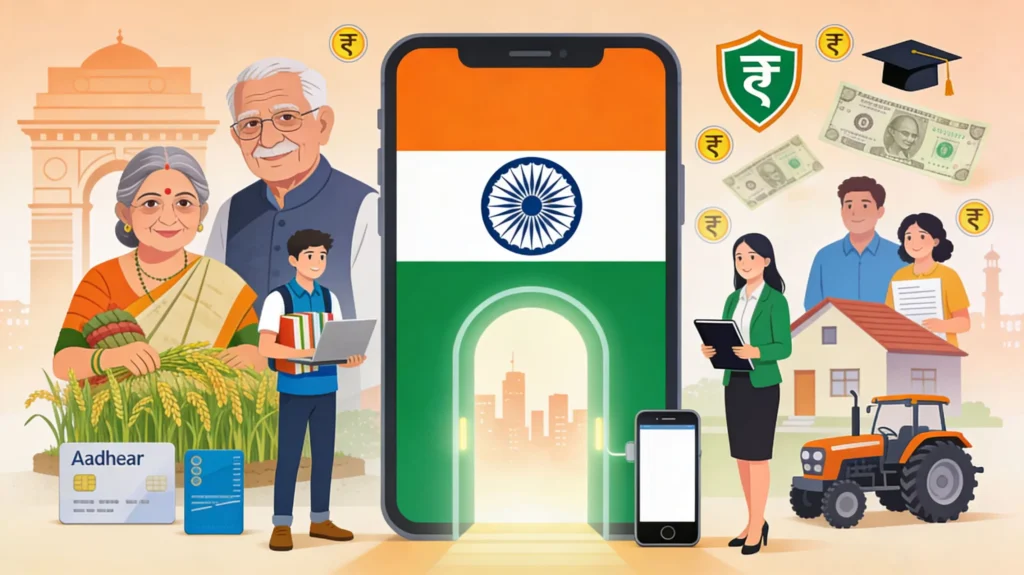
Government schemes in India are designed to provide financial support, social security, and essential services to every section of society, from farmers and workers to students, women, and senior citizens. A well-updated Sarkari Yojana list helps citizens quickly identify which benefits they can claim in 2026, how to apply online, and how to track their status without middlemen. In the last few years, the government has expanded direct benefit transfer (DBT), digital KYC, and unified portals so that money goes straight to bank accounts linked with Aadhaar, reducing leakages and fraud.
At the same time, fake “scheme” websites and WhatsApp forwards have increased, promising unrealistic benefits or asking for registration fees. Genuine schemes are always notified on official portals like india.gov.in, services.india.gov.in, myScheme.gov.in or specific ministry websites, and application links invariably point to .gov.in or .nic.in domains. Never trust schemes that demand money to “approve” your application, ask for login OTPs, or claim instant large cash prizes in the name of Pradhan Mantri Yojana. CryptoBatter will only list schemes that are verifiable on official portals, and we always cross-check eligibility, benefits, and application URLs before publishing.
This complete guide to the Sarkari Yojana list 2026 covers central government Pradhan Mantri Yojana, major state government schemes in top 10 states, category-wise schemes (SC/ST/OBC/minority/differently abled), and step-by-step instructions to check eligibility, apply online, and track your application status. We will also alert you about common scam patterns, share 2026 budget highlights for new schemes, and explain how CryptoBatter’s upcoming “CryptoBatter Yojana” tools and notifications can help you never miss a benefit you are eligible for.
Section 1: How to find & apply for government schemes
Official government portals
- National Portal of India (india.gov.in): Single window for information and services of the Indian government, linking to central and state department pages and scheme details.
- National Government Services Portal (services.india.gov.in): Well‑categorised directory of online services and application links from different ministries, including many scheme application and status services.
- myScheme (myscheme.gov.in): National platform and “scheme marketplace” that lets you enter basic demographic, income and social details, then automatically suggests schemes you are eligible for and routes you to the official application page.
- MyGov & UMANG: MyGov is a citizen engagement platform; UMANG and other integrated apps often expose scheme services and status tracking in one place.
State-wise portals
Each state operates its own portals where you can view and apply for state government schemes, often also linked from myScheme. Examples:
- Karnataka: State schemes like Gruha Lakshmi, Gruha Jyoti, Anna Bhagya and Yuva Nidhi are documented on state government sites and curated lists, detailing benefits like ₹2,000 per month for women heads of households (Gruha Lakshmi) and free rice under Anna Bhagya.
- Other states (UP, Tamil Nadu, Gujarat, etc.) similarly publish scheme details on their own official sites, often accessible via the Integrated Government Online Directory (igod.gov.in) which links to verified state portals.
How to verify scheme authenticity
To differentiate genuine schemes from fake ones:
- Confirm the URL ends in .gov.in or .nic.in and appears on india.gov.in, services.india.gov.in, myScheme, or a known ministry/department site.
- Cross‑check scheme name and brief details on myScheme, which aggregates over 2,500 central and state schemes and provides official links, documents and eligibility guidelines.
- Avoid any “registration agent” who asks for fees beyond government‑notified service charges (for example, CSC may charge small fixed amounts for assisted applications, not large commissions).
- Reject any request for your internet banking passwords, UPI PINs, or OTPs; genuine portals will never ask for these.
Common Application process
While each Yojana has its own process, most follow these common steps:
- Check eligibility on myScheme or the official scheme page by entering demographic, income, and social details.
- Register or log in using mobile number, email, and sometimes Aadhaar, creating a profile on the portal.
- Fill in the online form with personal, family, income, occupation, and bank details, and upload required documents in the specified format.
- Submit and note your application or reference ID for tracking.
- Complete eKYC (often Aadhaar‑based OTP or biometric at CSC) if mandated, to ensure DBT benefits reach your Aadhaar‑seeded bank account.
Documents typically required
Most schemes require:
- Aadhaar card and proof of identity.
- Proof of residence (ration card, electricity bill, domicile certificate).
- Bank passbook or cancelled cheque for DBT.
- Income certificate and category certificate (SC, ST, OBC, minority, disability) where relevant.
- Educational documents for scholarship schemes, land records for farmer schemes, and age proof for pension/senior citizen schemes.
Status tracking methods
- Use scheme‑specific portals (e.g., PM‑KISAN, PMAY MIS, NSP, myScheme) and enter your application ID, Aadhaar, or mobile number to track status.
- Many portals also send SMS or email updates when your application is accepted, rejected, or when payment is disbursed.
- For PMAY, status can be checked on pmaymis.gov.in by name, father’s name and mobile number after submission.
Section 2: PM Modi’s flagship schemes (Pradhan Mantri Yojana)
Agriculture & farmers
PM‑KISAN (Pradhan Mantri Kisan Samman Nidhi)
- Benefit: Income support of ₹6,000 per year to eligible farmer families, paid in three equal instalments of ₹2,000 every four months directly into Aadhaar‑seeded bank accounts.
- Eligibility: All landholding farmer families as per scheme definition (husband, wife, minor children) are eligible, subject to certain exclusion criteria notified by the government.
- Online registration: Farmers can register via the PM‑KISAN portal (pmkisan.gov.in) or through Common Service Centres (CSCs).
- eKYC & Aadhaar linking: eKYC is mandatory to remain on the beneficiary list; farmers must update Aadhaar‑based eKYC online or via CSC, otherwise instalments may be stopped.
- Check payment status: Beneficiary status can be checked on the PM‑KISAN website using Aadhaar or mobile number, and instalment history shows credited amounts.
PM Fasal Bima Yojana (PMFBY)
- Provides subsidised crop insurance to farmers with premiums shared between farmers and government, covering yield loss due to natural calamities; details and enrolment are available through agriculture department portals and notified banks.
Kisan Credit Card (KCC)
- KCC offers flexible, revolving credit for crop and allied activities with simplified documentation and interest subvention for timely repayment; farmers can apply at banks and KCC is often integrated with PM‑KISAN beneficiaries for easier issuance.
Health Schemes
Ayushman Bharat – Pradhan Mantri Jan Arogya Yojana (PMJAY)
- Coverage: Up to ₹5 lakh health coverage per family per year for secondary and tertiary care hospitalisation, including pre and post‑hospitalisation expenses.
- Eligibility: Targets poor and vulnerable families identified in SECC‑2011; recent decisions also extend ₹5 lakh coverage to all citizens aged 70+ irrespective of income.
- Hospital list: Beneficiaries can access cashless treatment in over 27,000 empanelled public and private hospitals across India.
- Card download & verification: Ayushman card and eligibility can be checked online using mobile/Aadhaar and downloaded from PMJAY portals; hospitals verify via card and ID at admission.
Pradhan Mantri Suraksha Bima Yojana (PMSBY)
- Offers accidental death and disability insurance of ₹2 lakh at a nominal annual premium of around ₹12, auto‑debited from the bank account; enrolment is done through participating banks.
Pradhan Mantri Jeevan Jyoti Bima Yojana (PMJJBY)
- Provides life insurance coverage of ₹2 lakh at an annual premium of about ₹330 for bank account holders aged 18–50 years; coverage continues as long as premium is auto‑debited yearly.
Housing
Pradhan Mantri Awas Yojana (PMAY – Urban & Rural)
- Objective: Provide affordable housing to urban and rural poor with interest subsidy and assistance for home construction, purchase, or improvement.
- Subsidy details: Maximum interest subsidy for eligible EWS/LIG/MIG categories can go up to about ₹2.67 lakh depending on income segment.
- Online application: Applicants visit pmaymis.gov.in, select “Citizen Assessment”, choose the relevant category, enter Aadhaar, and fill personal, income, and bank details to submit the form.
- Status tracking: Application status can be checked on the PMAY MIS portal by name, father’s name and mobile number, or by application ID.
Financial inclusion
Pradhan Mantri Jan Dhan Yojana (PMJDY)
- Zero‑balance bank accounts with RuPay debit card, access to overdraft facility (up to ₹10,000 subject to conditions) and built‑in accident insurance cover, bringing unbanked households into the formal financial system.
Atal Pension Yojana (APY)
- Pension scheme for workers in the unorganised sector where subscribers contribute monthly until age 60 to receive a guaranteed pension, with government co‑contribution for eligible low‑income subscribers.
Pradhan Mantri Mudra Yojana (PMMY)
- Provides collateral‑free loans up to ₹10 lakh to micro and small enterprises under three categories: Shishu (up to ₹50,000), Kishore, and Tarun; applications are made via banks, NBFCs and online loan portals.
Education
PM Scholarship schemes via National Scholarship Portal (NSP)
- The National Scholarship Portal (scholarships.gov.in) is a centralised platform to apply for Pre‑Matric, Post‑Matric, Merit‑cum‑Means and other central government scholarships, especially for SC, ST, OBC, minorities and EWS students.
- Schemes include Top Class Education for SC students, scholarships for students with disabilities, and merit‑based scholarships under various ministries, with income limits and course‑level criteria.
Employment & skill development
- Pradhan Mantri Rojgar Protsahan Yojana (PMRPY) encourages formal employment by the government paying part of the employer’s EPF contribution for eligible new employees; details are available on labour and EPFO portals.
- MGNREGA guarantees wage employment in rural areas for at least 100 days, implemented through Gram Panchayats, with job cards and muster rolls accessible via state MGNREGA portals.
- Pradhan Mantri Kaushal Vikas Yojana (PMKVY) offers free short‑term skill training and certification through authorised training centres with placement assistance; course lists and centre locators are hosted on official skill development portals.
Women empowerment
- Beti Bachao Beti Padhao promotes girl child survival, protection and education through multi‑sectoral interventions.
- Sukanya Samriddhi Yojana is a small savings scheme for girl child with attractive interest and tax benefits, opened at banks or post offices.
- Pradhan Mantri Matru Vandana Yojana provides maternity benefit (such as ₹5,000 in instalments) to eligible pregnant and lactating women on fulfilling antenatal and child immunisation conditions; applications go via Anganwadi/health projects and online modules.
Senior citizens
- Pradhan Mantri Vaya Vandana Yojana (PMVVY) offers senior citizens a pension plan with assured returns through LIC.
- Senior Citizen Savings Scheme (SCSS) is a post office and bank deposit scheme with higher interest for citizens aged 60+, with 5‑year tenure and tax benefits.
- Varishtha Pension Bima Yojana is another LIC pension scheme for seniors, providing regular income with government‑backed returns.
Section 3: Major state government schemes (top 10 states)
Below is a compact overview; for each state, more schemes are discoverable via myScheme and the state portals.
Key state schemes table
Section 4: Schemes for specific categories
SC/ST schemes
- Post‑Matric Scholarship: Covers tuition fees, maintenance allowance, and sometimes hostel charges for SC and ST students pursuing Class XI to PhD, with income ceilings (often around ₹2.5 lakh per year for SC post‑matric).
- Pre‑Matric Scholarship: Supports school‑level SC/ST students to reduce dropouts through stipends and fee support.
- Top Class Education & National Fellowships: Top Class Education for SC students in premier institutions (IITs, AIIMS, NIRF top colleges), and national fellowships for higher studies including M.Phil/PhD.
OBC schemes
- Post‑Matric Scholarship for OBC: Provides financial assistance to OBC students studying beyond Class X, with annual support sometimes reaching ₹48,000–₹60,000 depending on scheme and level.
- National Fellowship for OBC: Funds M.Phil/PhD studies with higher annual assistance, supporting tuition and living expenses.
Minority schemes
- Pre/Post‑Matric and Merit‑cum‑Means Scholarships: Central schemes under Ministry of Minority Affairs provide income‑based scholarships for students from notified minority communities, processed via NSP.
- Maulana Azad National Fellowship: Previously supported higher education for minority students in research degrees, with details and status available through UGC and ministry notices.
Differently abled (persons with disabilities)
- ADIP Scheme: Provides assistive devices and aids to persons with disabilities, such as wheelchairs, hearing aids and prosthetics, through authorised implementing agencies.
- Scholarships for students with disabilities: Pre‑ and post‑matric scholarships and top class schemes under Ministry of Social Justice support students with ≥40% disability.
Section 5: How to check scheme eligibility
- Use myScheme eligibility checkers: Enter your age, gender, income range, state, occupation, social category and other attributes; the portal then lists schemes you likely qualify for along with detailed pages on eligibility and benefits.
- Review document requirements: Each scheme page on myScheme or NSP lists required documents like Aadhaar, bank details, category/income certificates, education certificates and disability proof where relevant.
- Income criteria: Many scholarships and welfare schemes specify maximum family income thresholds (for example, SC post‑matric scholarships often use ₹2.5 lakh per year, and some EWS schemes use higher limits like ₹4.5–₹8 lakh).
- Age & residency: Pension schemes and youth programmes have age bands, while state schemes usually require domicile certificates or proof of long‑term residence in that state.
Section 6: How to track application status
- PM and central portals:
- PM‑KISAN: Check beneficiary status and instalment history on pmkisan.gov.in using Aadhaar, account or mobile number.
- PMAY: Use pmaymis.gov.in “Check Status” option and search via application ID or by name, father’s name and mobile number.
- Ayushman Bharat: Verify card and eligibility and track e‑card generation via PMJAY portals and state health websites.
- NSP: Log into scholarships.gov.in to view application status, defects, and payment details for scholarship schemes.
- State portals and myScheme: State portals provide their own status pages; myScheme routes you to the official portal and often provides FAQs on tracking.
- SMS/email updates: Many portals send automated SMS or emails when your application is received, verified, approved or rejected, and when funds are released.
Section 7: Common issues & solutions
- Application rejected: Check the reason in the portal dashboard (such as missing documents or mismatched details) and, if permitted, correct and re‑submit or apply afresh following the latest guidelines.
- Payment pending or failed: Ensure bank account is active, Aadhaar‑linked and correctly entered; in schemes like PM‑KISAN, incomplete eKYC is a common reason for instalment stoppage, so completing eKYC can resume payments.
- Document verification problems: Follow the specific document format and size instructions on the portal; some schemes allow re‑upload if defects are flagged during verification on NSP or other platforms.
- Grievance redressal: Use helpline numbers and grievance forms listed on scheme pages or portals like myScheme and NSP, which often include contact details for nodal officers and support email IDs.
Section 8: Fake scheme alert
- How to spot fake schemes: Beware of schemes that exist only on social media, use unofficial payment links, or copy names similar to popular PM Yojanas but point to non‑government domains.
- Common scam patterns: Fake “registration” forms asking for processing fees, messages promising lottery‑style awards in government scheme names, and calls claiming to “speed up approval” for a commission are classic fraud signals.
- Never pay for benefits: Genuine government benefits are free, although small service charges may be collected at CSCs for filling online forms; no one can legally guarantee approval in exchange for money.
- Reporting fraud: Citizens can complain to local cyber cells, consumer helplines, or report suspicious links on MyGov and to concerned departments, and should alert friends and family to avoid those scams.
Section 9: New and upcoming schemes in 2026
The Union Budget 2026–27 has introduced and expanded several schemes focusing on manufacturing, MSMEs, agriculture, and social sectors. Some notable initiatives include:
- Biopharma SHAKTI: A ₹10,000 crore programme over five years to boost India’s biologics and biosimilars capacity through infrastructure support and expanded clinical and biopharma capabilities.
- India Semiconductor Mission 2.0 & Container Manufacturing Scheme: Budget initiatives to strengthen high‑value manufacturing and strategic sectors.
- SME Growth Fund & Corporate Mitras: New MSME and business support mechanisms providing equity funding and professional compliance support.
- Bharat Vistar & PM Dhan‑Dhaanya Krishi Yojana: Agriculture‑focused schemes integrating AI‑enabled devices and improved support for productivity and food security.
- Expanded health and education outlays: Increased allocation (for example, ₹1.06 lakh crore for the Health Ministry and support for girls’ hostels) aims to reinforce social infrastructure, complementing existing schemes like PMJAY and scholarship programmes.
Citizens should regularly check india.gov.in, services.india.gov.in and myScheme for newly onboarded 2026 schemes as departments roll out detailed guidelines and online modules.
FAQs:
1. How to apply for government schemes online?
Use myScheme to discover eligible schemes, then click through to the official .gov.in or .nic.in portal, register with your mobile/Aadhaar, fill the online form, upload documents and submit.
2. Which documents are needed for most schemes?
Aadhaar, proof of residence, bank details, income certificate, caste/category or disability certificates where applicable, and educational documents for scholarship and youth schemes.
3. Are government schemes free?
Government benefits themselves are free; portals do not charge for online applications, though CSCs may levy small service charges for assisted applications.
4. How to check if I’m eligible?
Use myScheme’s eligibility checker by entering your demographics and income, or read the eligibility section on the official scheme page or NSP listing.
5. How long does approval take?
Timelines vary: scholarships process over weeks to months, while PM‑KISAN instalments follow fixed cycles after verification; portals like NSP and PM‑KISAN show status updates at every stage.
6. Can I apply for multiple schemes?
Yes, you can apply for multiple schemes if you meet eligibility criteria, but some scholarships and benefits may not allow duplication and require you to choose one main scheme.
Conclusion & CryptoBatter’s role
Staying updated with the latest Sarkari Yojana list is critical to maximising the government benefits available to your family and business in 2026. CryptoBatter plans to curate verified scheme lists, state‑wise and category‑wise filters, benefit calculators (such as PM‑KISAN income support and PMAY subsidy estimates), and monthly updates aligned with new government notifications to help you act quickly on new opportunities.
You can encourage users to subscribe to CryptoBatter’s email list or WhatsApp notifications so they receive alerts whenever a new scheme opens or eligibility rules change, and offer downloadable PDF guides summarising the most important central and state schemes for easy offline reference.