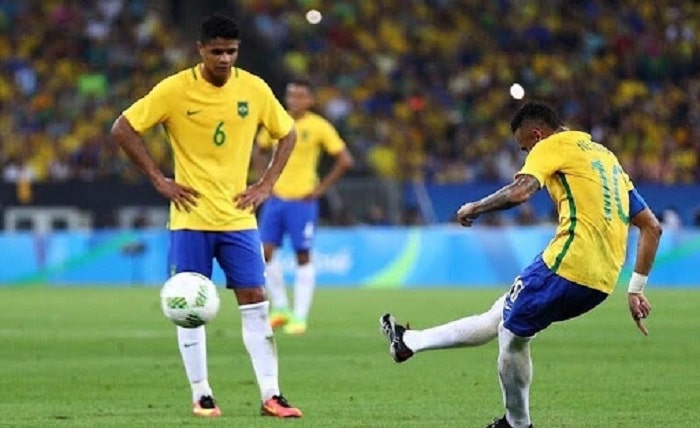
A penalty kick in football is one of the most special situations in the beautiful game. Just one shot from 11 meters can completely change the course of a match. The team awarded a penalty has a major opportunity to score, while the goalkeeper faces tremendous pressure.
Anyone who regularly watches football has surely witnessed players stepping up to the 11-meter spot. Some shots send millions of fans into celebrations, while missed penalties can become a source of regret and haunting memories for players for years.
So, what exactly is a penalty kick in football? When does the referee award a team a penalty? How is a penalty taken, and what rules need to be kept in mind? If you are also interested in this topic, join Xoi Lac TV as we explore it in the article below!
What is a penalty kick in football?
A penalty kick, also known as a penalty, is a direct free kick taken from the penalty mark inside the penalty area of the team that committed the offense.
According to Law 14 of IFAB, a penalty kick is awarded when a player commits an offense punishable by a direct free kick inside their own penalty area.
The penalty mark is 11 meters from the goal line. The player taking the penalty faces the opposing goalkeeper directly.
This is one of the clearest opportunities to score in football. However, finding the back of the net is not always easy because the goalkeeper can anticipate the direction of the shot and make a save.
When is a penalty awarded?
Not every offense committed inside the penalty area automatically results in a penalty. The incident must meet the conditions for an offense punishable by a direct free kick.
Xôi Lạc TV lists some common offenses that can result in a penalty, including:
- Deliberately handling the ball with the hand or arm in violation of the Laws.
- Kicking or attempting to kick an opponent.
- Tripping or attempting to trip an opponent.
- Pushing, holding, or pulling an opponent.
- Making an illegal challenge or contact during a contest for the ball.
- Committing another offense inside the penalty area that is punishable by a direct free kick.
Depending on the nature of the incident, the offending player may also receive a yellow or red card. Therefore, a penalty can sometimes do more than put a team at risk of conceding a goal; it can also change the number of players on the pitch.
How to take a penalty kick in football
A penalty is taken from the penalty mark. According to Law 14, the designated penalty taker must be clearly identified and must not use an illegal action to confuse the goalkeeper after the referee has given the signal.
The ball must be stationary on the penalty mark before the kick is taken.
At the moment of the penalty kick, the goalkeeper must remain on the goal line, facing the kicker and between the goalposts until the ball is kicked. The goalkeeper must not touch the goalposts, crossbar, or net in a way that affects the kicker’s action.
All other players must remain outside the penalty area, behind the penalty mark, and at least 9.15 meters away from the penalty mark until the kick is taken.
Once the referee gives permission, the penalty taker must kick the ball forward. The kicker may not touch the ball a second time before it has touched another player. Watching penalty kicks in tuong thuat truc tiep bong da always brings an intense sense of excitement.
Can a player pass the ball during a penalty kick?
This is a rather interesting situation in football. Under the Laws, the player taking a penalty does not necessarily have to shoot directly toward the goal in the conventional manner. The ball simply has to be kicked forward.
This means that, from a rules perspective, a player can make a light touch on the ball to allow a teammate to run in and support the play, provided the players comply with the positional requirements and the ball is played forward.
However, this is a very rare way of taking a penalty and requires extremely precise coordination. If the teammate is not ready or the opponents read the intention, the scoring opportunity can disappear very quickly.
What happens after a penalty is taken?
If the ball legally enters the goal, the goal is awarded.
If the goalkeeper saves the ball but it remains in play, the players can continue participating in the play according to the Laws. The penalty taker cannot touch the ball a second time until it has touched another player.
According to Xoilac Tivi, this is why rebounds after penalties can sometimes create dangerous contests inside the penalty area.
If the ball goes directly out of the goal, the team taking the penalty does not score and play resumes according to the applicable rules. The outcome of a penalty kick can change the kết quả bóng đá tối qua which is why fans eagerly await these moments.
Common errors when taking a penalty kick
A penalty may seem very simple, but there are actually many rules that must be followed.
The penalty taker can be penalized for touching the ball a second time before it has touched another player. Meanwhile, the goalkeeper must also comply with the positional requirements before the kick is taken.
If an attacking or defending player enters a restricted area at the wrong time, the referee will apply the appropriate decision based on whether the action has affected the outcome of the kick.
Therefore, the referee and VAR team must closely monitor penalty situations, especially in important matches.
Conclusion
A penalty kick in football is a special situation taken from the 11-meter mark when the defending team commits an offense punishable by a direct free kick inside its own penalty area.
From club-level matches to international competitions, penalties have created countless memorable moments. These emotions have helped give penalty kicks in football their unique appeal and ensure that the beautiful game always has memorable stories to tell after every match.