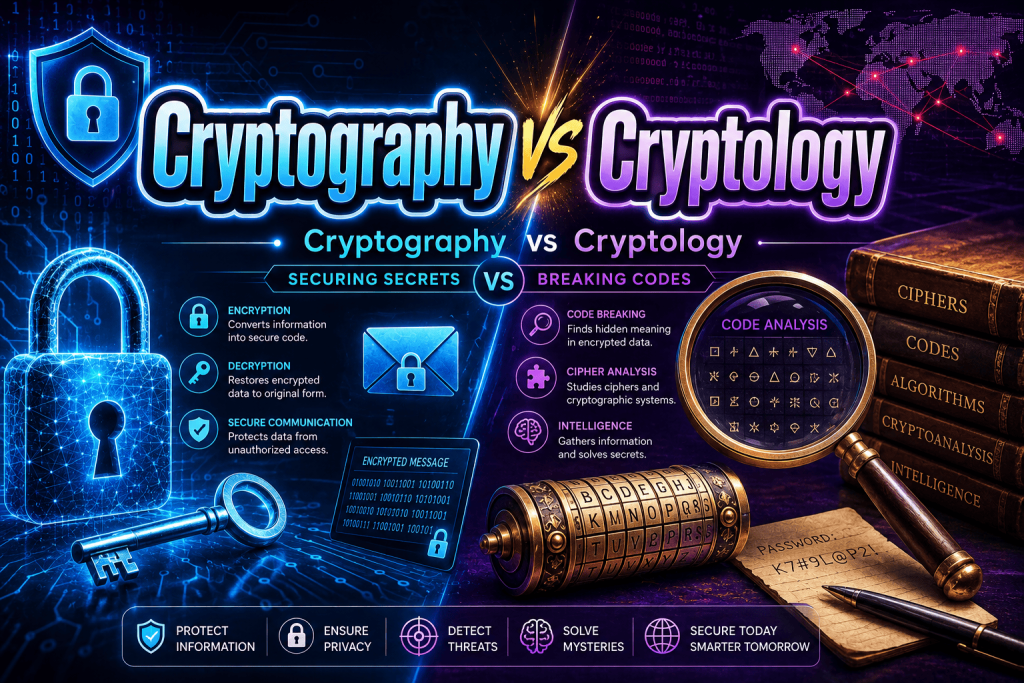
Cryptography vs Cryptology explained with clear differences, real world uses, types, and how these technologies protect modern digital information securely.
In the digital age, protecting sensitive information has become more important than ever. Cryptography vs Cryptology is a common confusion, but both fields play different roles in cybersecurity. While one focuses on securing data, the other explores the complete science behind secure communication. Discover how these technologies work together to protect modern digital information from cyber threats.
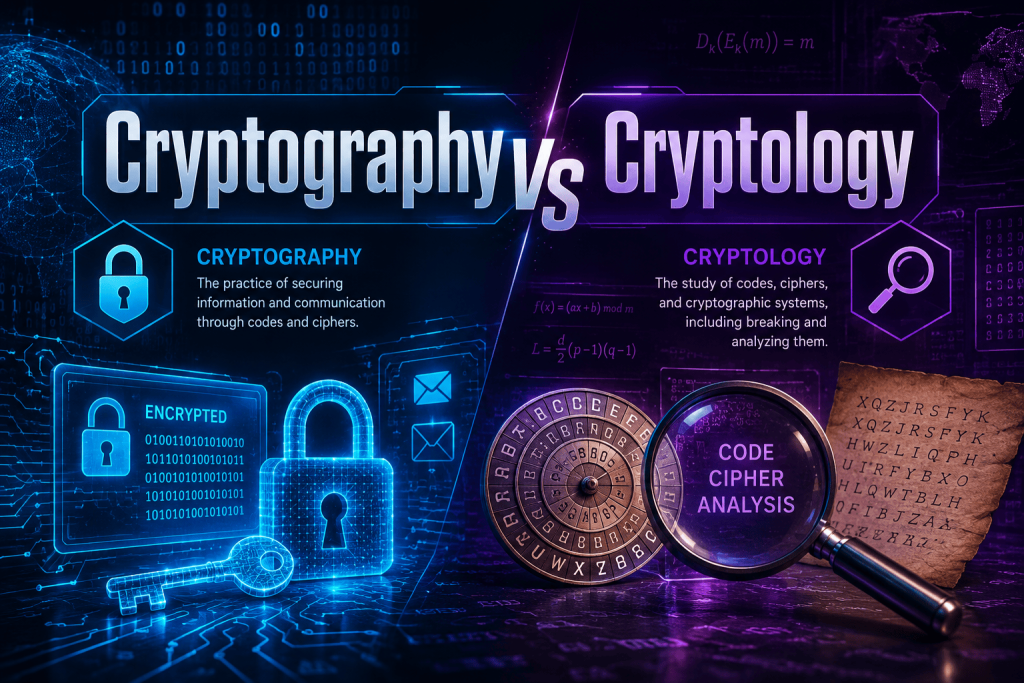
What Is Cryptography?
By modifying unreadable data, cryptography can be utilized to protect information. By using this method, the original information can only be viewed and understood by authorized users.
Two Greek words that are related in the context of cryptography are:
- “Kryptos” means hidden.
- “Graphia” means writing.
The term hidden writing is used in conjunction with cryptography.
The use of mathematical methods and algorithms to protect communication is known as cryptography. Additionally, it safeguards confidential business data, private messages, and passwords.
How Does Cryptography Work?
Does the encryption process in cryptography have a functioning mechanism? Is there any encryption used to generate cipher text from plaintext information? This is done through encryption. Only the original version can be decrypted by using a proper type of key, not the encrypted ciphertext.
The basic process includes:
- One sentence that encompasses encryption, cryptography, and data protection. How can you tell if something is truly “natural”.
For example:
When an app is encrypted, a private message sent to the user’s device is transmitted in its own code, which other users cannot read. The information intercepted by an attacker is inaccessible because it does not contain the correct deciphering key.
Purpose of Cryptography
Digital communications are most protected and private because of cryptography. It safeguards vital online data for both individuals and organizations.
Key purposes of cryptography are:
1. Confidentiality
Only authorized users with private information can use cryptography.
Example:
- Online banking details are protected.
2. Data Integrity
It also serves as proof that the transmission did not contain any changes or alteration of information.
3. Authentication
Users and systems are verified using cryptography before they can be accessed.
4. Non Repudiation
Users are prevented from halting the completion of actions such as digitally signing a document.
Read more: crypto demo account
Types of Cryptography
Cryptography is classified based on the encryption key type. Asymmetric encryption is the most widely recognized type, followed by symmetry encryption and hash functions.
1. Symmetric Cryptography
In symmetric cryptography, the same keys are used for both encryption and decryption.
In this method:
- A hidden code is used by the sender to store it.
- If a single key is used to decrypt the information.
Advantages:
- Faster processing speed.
- Powerful enough for large datasets.
- Requires less computing power.
Example:
Sharing the secret key between different users is primarily hindered by an inability to use symmetrical encryption algorithms.
2. Asymmetric Cryptography
In asymmetric cryptography, there are two distinct keys.
- Public key.
- Private key.
The public key is encrypted, whereas private keys are utilized.
Advantages:
- Provides stronger security.
- Secures private keys from being used for communication purposes.
- Supports digital signatures.
Examples:
Information is frequently transmitted through asymmetric encryption.
- Secure websites (HTTPS)
- Digital certificates.
- Online authentication systems.
3. Hash Functions
In cryptography, hashing is the fundamental process that converts input into output and enables the hashes value to be transferred in an observable timeframe.
Unlike encryption, hashing is not transferable to other systems. This means that normally a hash cannot return its original information.
As an instance, hash functions are commonly utilized to:
- Password storage.
- File verification.
- Blockchain security.
What Is Cryptology?
Information security and secure communication are the main focus of cryptology. This group encompasses both the establishment of secure systems and their examination and removal.,
In simple terms:
Cryptography is credited with the creation of security methods, while cryptology covers every aspect related to safeguarded communication.
Cryptology combines two major areas:
- Cryptography.
- Cryptanalysis.
The primary objective of cryptology is to protect information and identify vulnerabilities in security systems.
Components of Cryptology
Researchers can gain knowledge, develop secure communication systems, and improve them through the use of cryptology. Two major branches of cryptology are cryptanalysis and cryptography.
1. Cryptography
Cryptography is the process of storing information by devising mechanisms and algorithms that prevent its unauthorised disclosure.
We need to create effective communication strategies that ensure the protection of personal information.
Encryption specialists use cryptographic techniques:
- Secure messaging applications.
- Online banking systems.
- Digital certificates.
- Password protection.
- Blockchain networks.
Verification safeguards sensitive information.
2. Cryptanalysis
Astrologers are involved in the study and destruction of cryptographic systems. This is to identify weaknesses in encryption methods and find ways of accessing protected information.
Security measures are tested through cryptography, while cryptology provides evidence.
Cryptanalysts try to:
- Find security weaknesses.
- Analyze encryption algorithms.
- Improve cybersecurity defenses.
- Detect possible attacks.
To maintain the security and effectiveness of modern encryption methods, encryption analysis is essential.
Cryptography vs Cryptology: Key Differences
Although they are closely related, cryptography and cryptocurrency are used for separate purposes.
| Feature | Cryptography | Cryptology |
| Meaning | What steps should we follow to safeguard our means of communication? | A comprehensive analysis of information and secure communication. |
| Scope | A specific area of cybersecurity. | A comprehensive overview of cryptography and cryptanalysis. |
| Main Focus | Protecting data through encryption techniques. | Designing, observing and improving security measures. |
| Includes | Encryption, decryption, and security algorithms. | Cryptography and cryptanalysis. |
| Goal | Keep information confidential and secure. | Discover reliable means of communicating. |
| Used By | Security engineers and developers. | Researchers, cybersecurity experts, and analysts. |
The simple difference is:
While symbols (and graphs) are used in cryptology, they are not exclusive to the scientific disciplines of graphics.
Applications of Cryptography and Cryptology
Contemporary technology focuses on cryptography and cryptology. Most digital services are subject to some form of encryption or security analysis.
1. WhatsApp End to End Encryption
Private conversations are secured on messaging systems. The sender and recipient are the only individuals who can read encrypted messages.
But despite several intercepts, the encrypted information is still not revealed.
2. Online Banking Security
Banking institutions employ digital locks to secure:
- Account information.
- Online transactions.
- Customer details.
- Payment records.
Encryption prevents the possibility of unauthorised access and financial fraud.
3. Password Protection
Hashing passwords for websites and apps is the outcome.
Systems store the original password and the hash value. The risk of security breach is less significant than that of password theft.
4. Digital Signatures
Are digital certificates encrypted? Why are electronic signatures protected by cryptography?
They help confirm:
- Who created the document?
- Whether the information was modified.
- Whether the sender is trustworthy.
5. Blockchain Transactions
Cryptography is used to secure almost all electronic transactions in a blockchain.
Cryptographic methods help protect:
- Cryptocurrency transfers.
- Transaction records.
- Digital identities.
Blockchain networks would be safe and secure without the use of cryptography.
Why Are Cryptography and Cryptology Important?
Why are private companies and governments being targeted by cyber attacks?
Cryptography serves as a means of safeguarding information, while cryptology is concerned with comprehending and improving security systems.
These technologies provide protection against:
- Data breaches.
- Identity theft.
- Cyber attacks.
- Unauthorized access.
- Online fraud.
Future of Cryptography and Cryptology
Technology advancements will make cryptography and cryptology more crucial. The need for increased security measures is due to the emergence of new threats, such as those from artificial intelligence and quantum computing.
Future developments include:
Quantum Resistant Cryptography
Scientists are developing new encryption methods that can protect data from powerful quantum computers.
AI Based Security Analysis
By utilizing artificial intelligence, we can recognize threats, detect unusual activities, and enhance cybersecurity measures.
Advanced Privacy Technologies
The focus of future systems will be on enhancing privacy and facilitating secure digital communication.
What carries more weight: cryptography or cryptology?
Both areas are important despite their similar functions. Secure systems and information are made secure by cryptography. The absence of cryptography would leave online communication, banking, and digital services vulnerable.
Cryptology examines the weaknesses associated with security, as well as the ways in which it can be safeguarded and protected.
In simple words:
- Cryptography builds the lock.
- Trying to find the lock, Cryptanalysis.
- Cryptology studies the entire process.
Would it be better to study cryptography or cryptology?
Cryptography is a fundamental subject that can be learned by both students and beginners in cybersecurity through the study of encryption, keys, or algorithms.
Once cryptography is learned, students can move on to further studies in cryptology and specialized research into security topics.
Career prospects in these fields include:
- Cybersecurity Analyst.
- Cryptographer.
- Security Engineer.
- Blockchain Developer.
- Information Security Specialist.
Conclusion
A clear differentiation between Cryptography and Cryptology is necessary to comprehend digital security in the 21st century. Although cryptography focuses on information security, cryptology encompasses all aspects of secure communication, including the development of encryption techniques and machine learning.
Digital identity, blockchain technology, and online banking are crucial to safeguarding the internet.
FAQs About Cryptography vs Cryptology
Is cryptology the same as cryptography?
No, cryptology and cryptography are not exactly the same. Cryptography is a part of cryptology that focuses on creating secure communication methods, while cryptology also includes cryptanalysis.
Which is broader, cryptography or cryptology?
Cryptology is broader because it includes both cryptography and cryptanalysis.
Is cryptanalysis part of cryptology?
Yes, cryptanalysis is one of the main components of cryptology. It focuses on studying and testing the security of encryption systems.
Why is cryptography important today?
Cryptography protects sensitive information such as financial data, passwords, personal messages, and online transactions from cyber threats.
Can cryptography be broken?
Some encryption methods can become weak over time, especially with advanced technology. That is why researchers continuously improve cryptographic algorithms.